
NeuroIrideV1.4
NeuroIride

Neurodiversity spectrum

A clinical and research project by Lifeology

The great spectrum of neurodiversity

NeuroIride is a platform for mental health professionals. It brings together questionnaires on attention, autism, learning, tics, sensory processing and adjustment in a single profile, so that an adult's functioning can be read as a set of shades that combine with one another.

NeuroIride does not make diagnoses: it supports the professional's assessment, within a clinical interview and a personal history.

Sample profile on the NeuroIride polar chart ADHD: 72; Tics/Tourette: 30; OCD: 44; Autism: 58; Affective/cognitive empathy: 47; High sensitivity: 52; Sensory: 66; Dyslexia: 38; Dyscalculia: not assessed; Dyspraxia: 46; Language/Fluency: 26; Adjustment: 61 ADHD 72 Tics/Tourette 30 OCD 44 Autism 58 Affective/cognitive empathy 47 High sensitivity 52 Sensory 66 Dyslexia 38 Dyscalculia not assessed Dyspraxia 46 Language/Fluency 26 Adjustment 61
Sample profile with made-up values. Each spoke is an area, the colours are the families, the dashed line is the threshold.

Why an iris

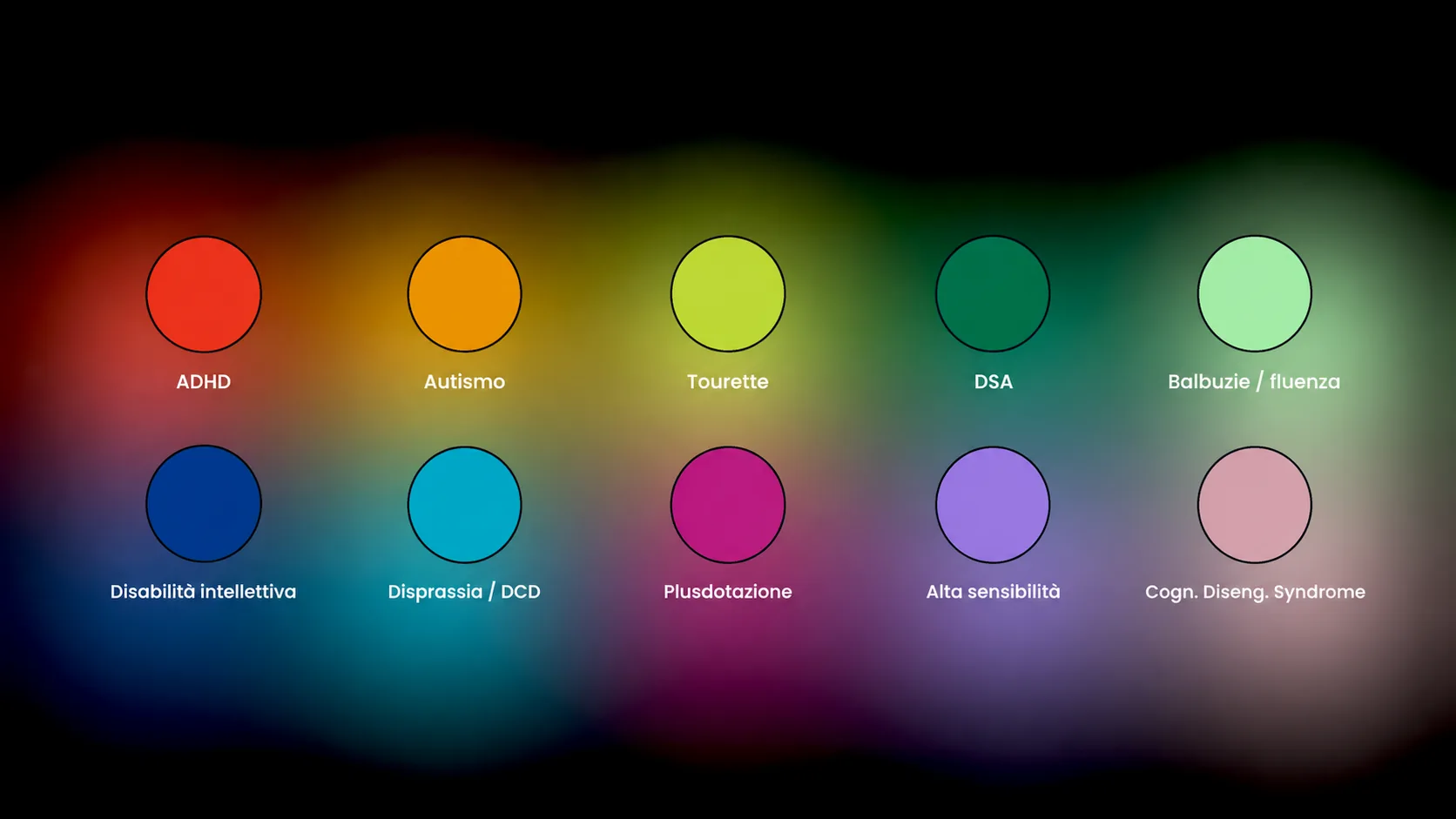
The project's name is Italian, and in Italian the word iride means two things: the coloured part of the eye, different in each of us, and the rainbow. We love both. ADHD, autism, dyslexia, tics and sensory sensitivity are like the colours of the spectrum, and in the same person they blend at different intensities, in a profile that belongs to that person alone.

Ten coloured circles, one for each neurodevelopmental area, surrounded by halos that fade into one another.
No one is a single colour.

Read Valerio Rosso's essay on the great spectrum

12 areas, 4 families

A profile of the whole

Attention and regulation, social and sensory, learning and motor skills, adjustment. Each area receives a score from 0 to 100 with the threshold at 50, so that different instruments become comparable on the same chart.

Two levels

Screening first, then in-depth assessment

The assessment starts with short questionnaires. When one goes above its threshold, the platform suggests the full test for that area. You go deeper where it is needed, without burying the person under questions.

Over time

A profile that keeps up to date

Tests can be added later and different sessions compared. Every result keeps its date, because the state of a difficult period and lifelong traits need to be read differently.

NeuroIride is designed and used by Lifeology, a group of mental health professionals who support neurodivergent adults from assessment through to psychoeducation.

For individuals

People who come to an assessment as adults often bring with them a history of partial labels, collected at different times. The NeuroIride profile helps the professional give back an overall picture, in plain language and with a report written for the person who receives it.

Assessment with NeuroIride takes place within the programmes of the professionals who use it. For information about Lifeology's programmes (the Lifeology website is in Italian):

Contact Lifeology

For professionals

Clinician-guided administration, scores and explanations for every instrument, a polar chart, a printable report for the person, tracked corrections and pseudonymised data that can be exported for research.

Access is by invitation only and restricted to licensed professionals.

How it works