
The great spectrum
What does your spectrum look like?
For years I have watched people walk into my consulting room holding pieces of paper. Labels. Sometimes just one, more often two or three, collected at different points in their lives from different professionals, each of whom had looked at one piece of the person and given that piece a name. Dyslexia at primary school. Anxiety at secondary school. Depression at thirty. And then, perhaps at forty, someone finally says: look, there may be ADHD here, and perhaps something that resembles autism too. The question I asked myself back then, and still ask myself today, is a simple one: and where was the person in all this?
NeuroIride was born from that question. And to explain where it comes from, I need to start with a word that in recent years has changed the way many of us look at the human mind: spectrum.
When people talk about a spectrum, almost everyone pictures a line. A little at one end, a lot at the other, like a volume knob. You are a bit autistic, you are very autistic. You have a bit of ADHD, you have a lot of it. Can you see how this image, however convenient, leads us astray? It reduces something complex to a single measure, and makes us believe that somewhere along that line there is a precise point where you jump cleanly from normal to pathological.
Clinical reality is far more interesting, and far more respectful of people. The spectrum resembles the one produced by light passing through a prism: many different bands, each with its own intensity, which together make up a unique colour. Attention and impulse regulation are one band. The way you are in relationships and read social signals is another. Then there is sensitivity to stimuli, the noise that for one person is background and for another is a drill in the brain. There is reading, arithmetic, movement coordination, and there are tics. Each of us has our own mix, and the mix matters at least as much as the individual bands.
From Islands to Colours
ADHD, autism, specific learning disorders, tics and Tourette syndrome, dyspraxia: for a long time medicine studied them as separate islands, each with its own specialists, its own conferences, its own questionnaires. The fact is that in practice these islands touch all the time. Consider that until 2013 the American diagnostic manual did not even allow autism and ADHD to be recognised in the same person. Today we know that they frequently occur together and that the two conditions share part of their genetic architecture. Anyone who works with neurodivergent adults sees it every day: it is rarely just one thing.
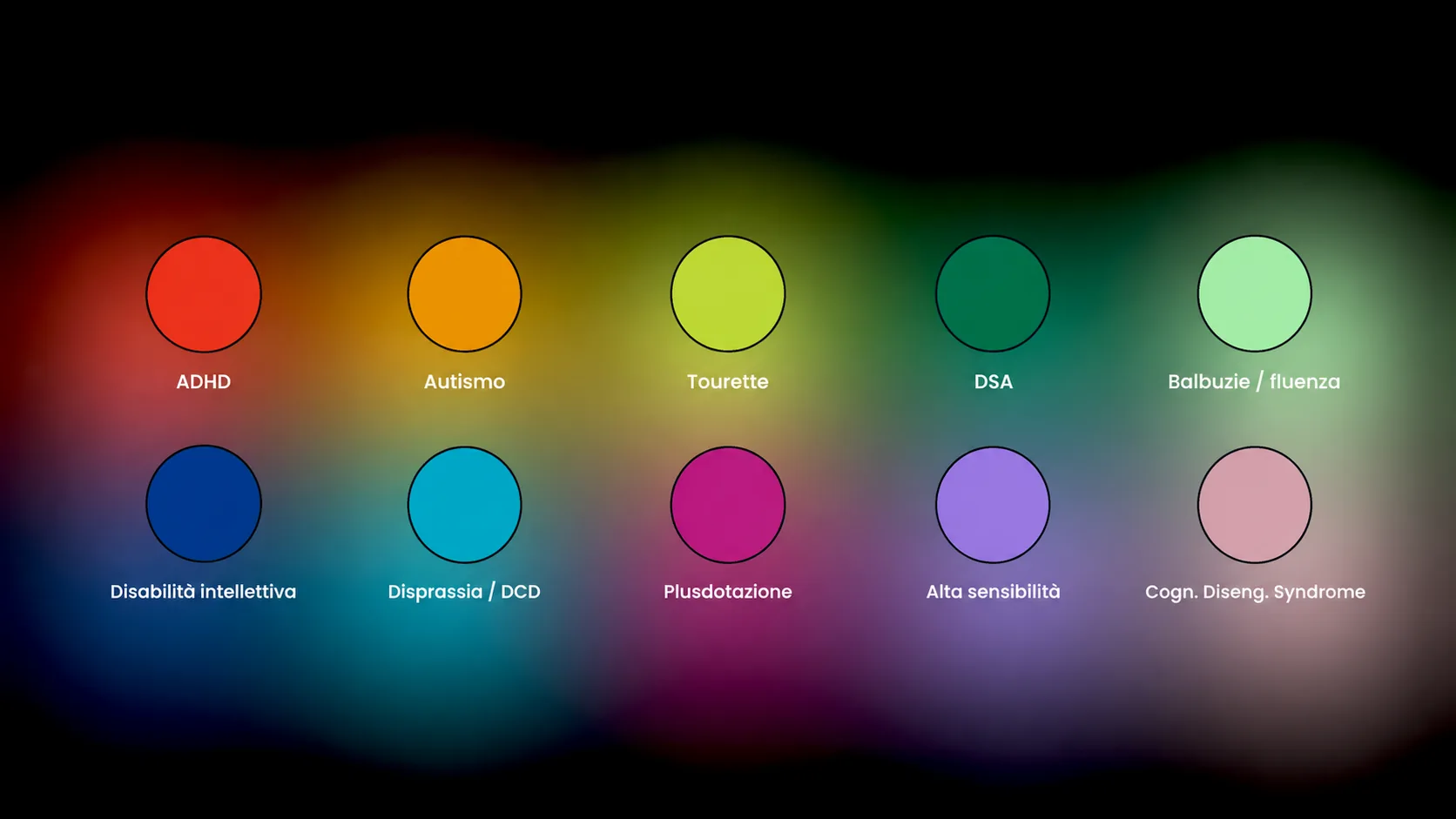
So let us try changing the image, and move from islands to colours. Take the rainbow strip, the one that comes out of the prism, and put each major neurodevelopmental area in its place. ADHD on red, autism on orange, Tourette syndrome towards yellow, stuttering and fluency disorders on light green, specific learning disorders on deep green, dyspraxia on sky blue, intellectual disability on blue. These are seven macro-areas that have a name and a code in the diagnostic manuals: each has its own wavelength, its own precise place on the strip.
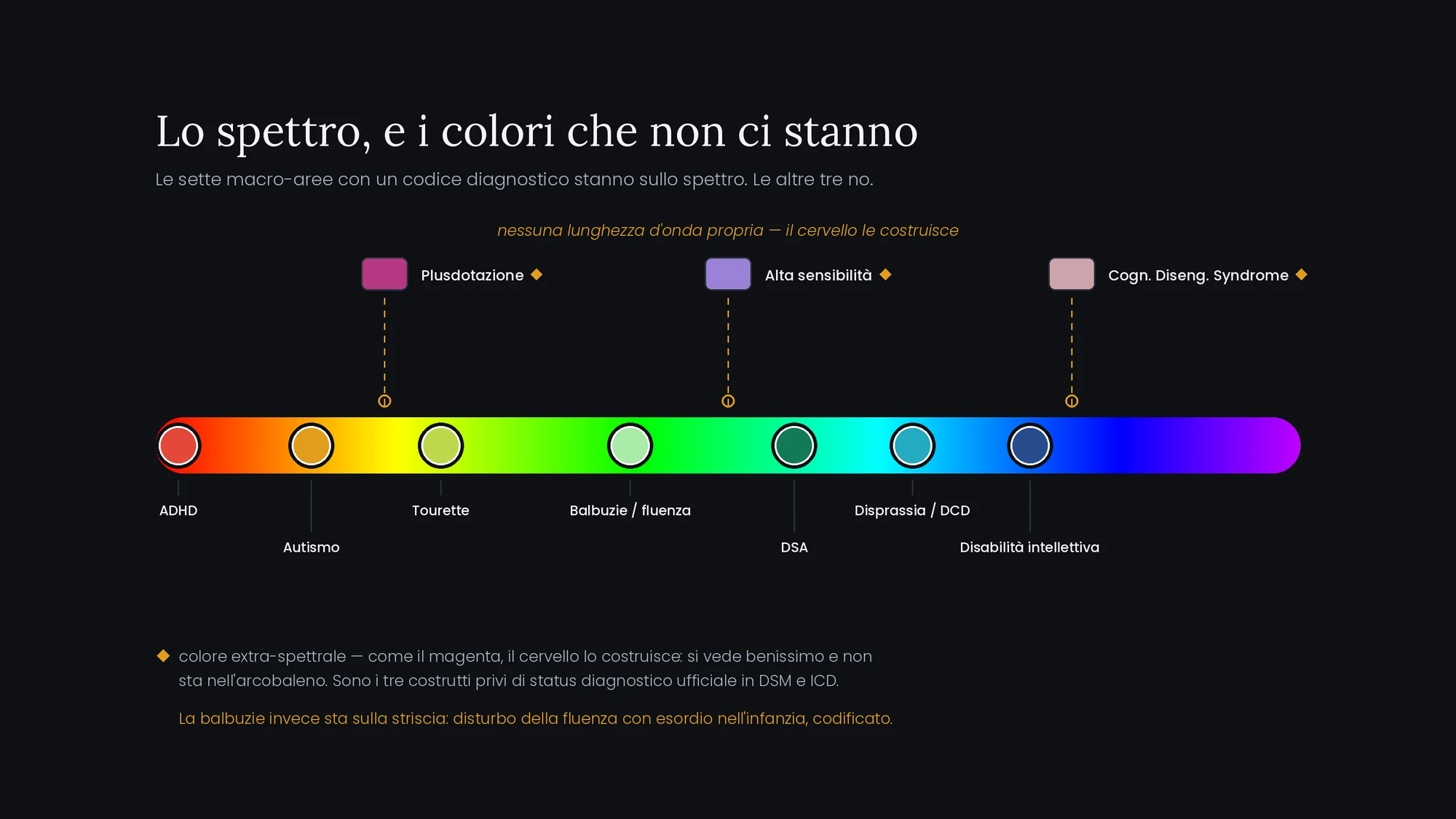
Then there are the colours that do not fit on the strip. Magenta, for example. In physics magenta does not exist: no wavelength produces it. It is our brain that builds it, when red and blue reach it together, and yet we see it perfectly well. Giftedness, high sensitivity and Cognitive Disengagement Syndrome (what used to be called sluggish cognitive tempo) work a little like that. In the consulting room they are recognisable, very much so, and they make a real difference to people's lives, but in the DSM and the ICD they have no official diagnostic status. They deserve attention and, at the same time, a great deal of caution: high sensitivity, for instance, I consider a temperament trait, and we measure it because it helps to read the profile, without turning it into a condition.
And this is where the name we chose comes in. In Italian the word iride says two things. It is the coloured part of the eye, the part that is not the same in any two of us, which is why it is even used to identify people. And it is the rainbow: Iris, in Greek myth, was the messenger of the gods who came down to earth along a trail of light, and it is no coincidence that Italians still speak of the colours of the iride. Look closely at an iris and you will notice that it is never a single colour: there are rays, flecks, rings, shades that blend together.
A person works in the same way. No one is red or blue. Someone is very red, with a band of green and a touch of magenta; someone else is an intense orange that fades into sky blue. The colours overlap and bleed into each other, and the result is a blend that belongs to that person alone.
That is why the heart of NeuroIride is a polar chart. Twelve spokes, grouped into four families, each with its own score. Its purpose is to show the shape of that person's functioning: where the bands are intense, where they are faint, where we simply have not looked yet. Today the platform measures part of this palette, and says so openly: where we have not looked, the chart stays empty, and it never counts as zero.
Then there are the border areas, and here too I want to be cautious. Obsessive-compulsive disorder sits on an edge, with many links to neurodevelopment and many differences. Trauma, on the other hand, I keep outside the definition of neurodivergence, even though it very often intertwines with the history of people who are neurodivergent. And this should come as no surprise: growing up in environments that do not understand you, that correct you constantly, that mistake your way of functioning for unwillingness, leaves deep marks.
The brain and the environment
And here we come to what is, for me, the most important point of all. The suffering of a neurodivergent person very often arises from the encounter between their brain and the environment they live in. A noisy open-plan office, a job made of constant interruptions, a school that rewards only one way of learning: the same brain that falls apart in that context can breathe in another. I myself spent seven years in a mountain valley, and I learned first-hand how much the environment can make the difference between strain and wellbeing.
That is why in NeuroIride we wanted one more spoke, dedicated to adjustment difficulties. It measures how much a person is struggling to adapt to a stressful situation at this point in their life. It tells the story of a period of life and needs to be read together with the rest of the profile: a person with a strong need for predictability who has just lost their job, or moved to a new city, is not suffering by chance.
No romanticising
Let me say something clearly, because there is a narrative going around on social media that worries me. We are not all misunderstood geniuses. Suffering exists, disability exists, there are people who need support every day for things that seem trivial to others. Reading functioning in dimensions also serves this purpose: to see precisely where a person needs help, without denying where they function well. Let us stop kidding ourselves: a person's dignity also depends on recognising their difficulties.
I also say this from the inside. I am neurodivergent too, and my assessment came at forty. For me it was a liberation, and at the same time a kind of duty of professional amends: how many people had I looked at in fragments, before realising I was doing the same with myself?
A chart is not a person
One last thing, and it matters to me. A questionnaire measures what a person reports at a given moment, with their tiredness, their mood, their habit of masking. A chart, however beautiful, remains a tool. We built NeuroIride for professionals, so that the profile is read within a clinical interview, within a life story, within a relationship. No score, on its own, tells you who you are.
But it can help us change the question. Instead of asking the person sitting in front of us what they have, we can try asking what their spectrum looks like, and in which environment their bands finally find the right light.